Industrial weighing is often treated as a small engineering function: choose a sensor, connect an indicator, calibrate the scale, and move on. In modern production, that approach is too narrow. Weight data may determine how much additive enters an extruder, when a filling valve closes, whether a batch is accepted, how a tank inventory is reconciled, or how an automated line responds to a process disturbance. If the weighing architecture is unstable, the consequences appear downstream as material loss, off-spec product, slow cycles, operator intervention, and difficult troubleshooting.
An industrial weighing system should therefore be designed as a complete measurement-and-control chain. The mechanical structure has to transfer force correctly. The load cells have to measure within a suitable range. The controller has to filter and update the signal quickly enough for the application. The automation layer has to use the data correctly. The communications architecture has to expose the right values to the PLC, HMI, historian, or plant network. Finally, the entire system has to be validated under realistic production conditions rather than only with a static calibration weight.
This guide explains how production engineers, plant managers, machine builders, and procurement teams can specify an industrial weighing system from the process objective backward. The focus is not a single device. It is how measurement, control, installation, data, and lifecycle support work together to produce reliable industrial results.
What Is an Industrial Weighing System?
An industrial weighing system is an integrated set of mechanical supports, weight sensors, signal-processing electronics, control logic, and communications used to measure mass and convert that measurement into a production decision.
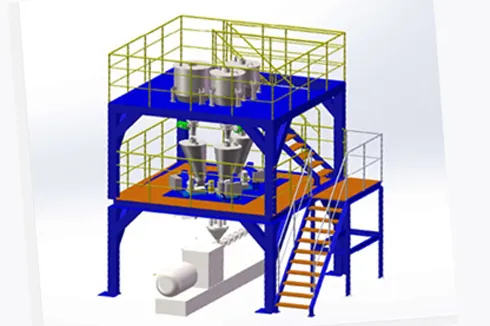
The simplest system may be a platform scale that displays weight to an operator. A more advanced system may weigh a hopper while a controller automatically starts and stops feeders, compensates for material in flight, records the result, and sends the final batch data to a PLC. A continuous process may use weight loss over time to control material flow. A tank system may track inventory rather than a short production cycle. The common element is that mass measurement is not isolated from the process around it.
For this reason, an industrial weighing system should be defined by function rather than by hardware count. A single load cell and an instrument can be a system if they provide the required process information. Four load cells under a large hopper can still be an incomplete system if the mounting, signal summing, calibration, and controls have not been engineered correctly. The design question is always: what decision must the weight measurement support, at what speed, with what repeatability, and under which plant conditions?
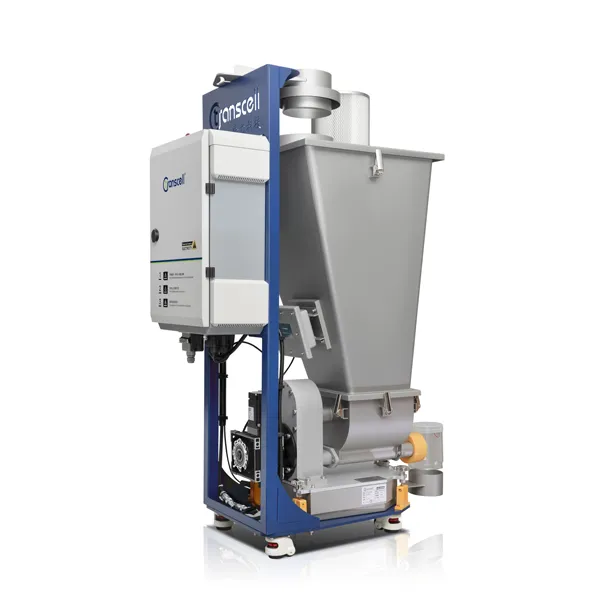
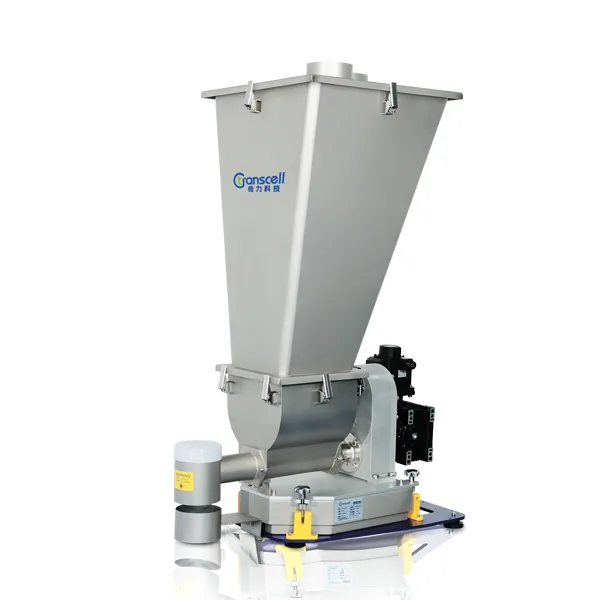
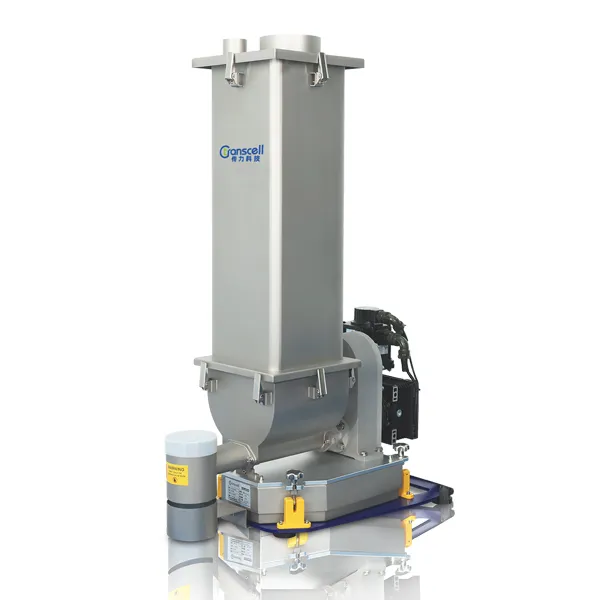
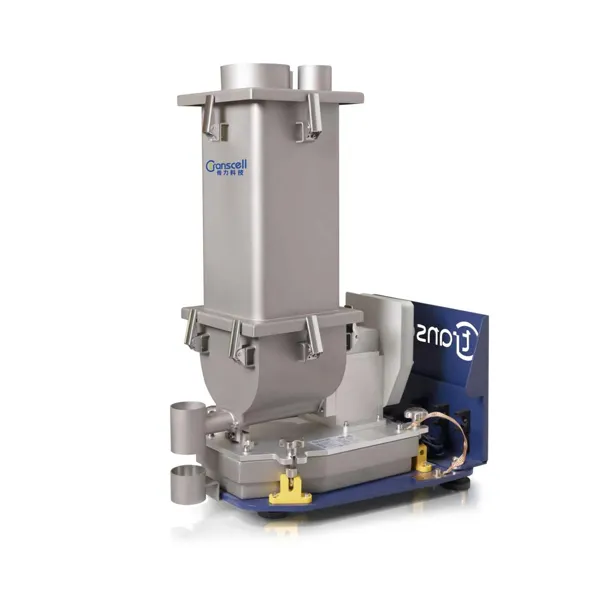
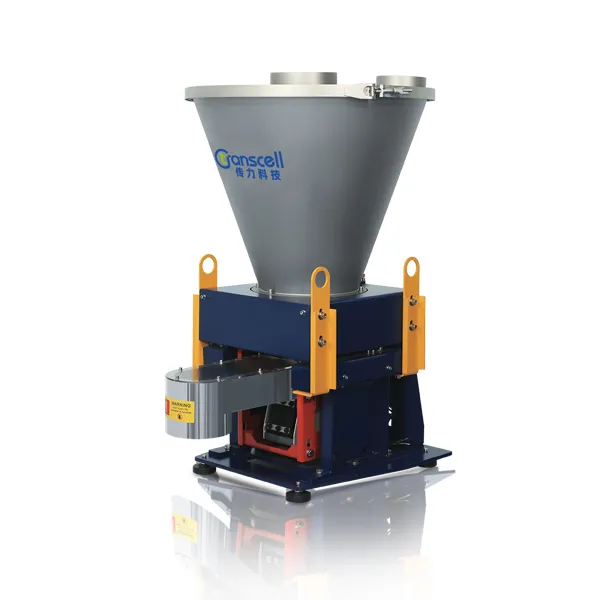
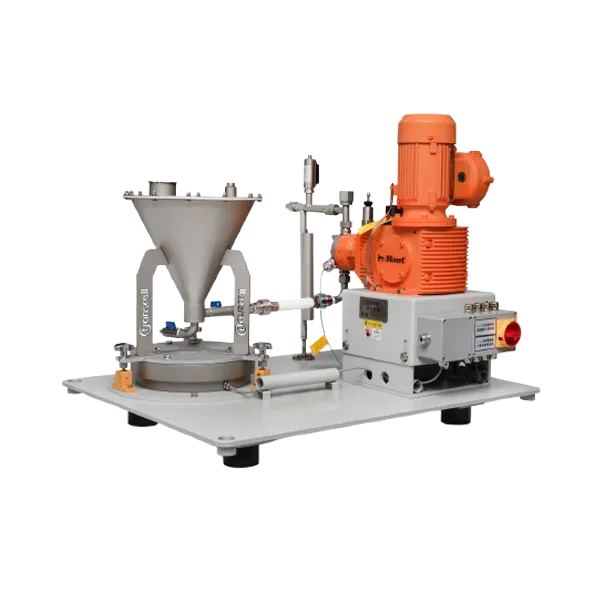
Transcell's product portfolio reflects this system view. The company provides load cells, weighing controllers, loss-in-weight feeders, and industrial intelligent control products, allowing customers to combine the sensing, control, and material-handling layers around the actual application rather than treating each component as a separate procurement exercise.
How Does an Industrial Weighing System Work?
An industrial weighing system works by transferring a physical load into sensors, converting sensor output into a stable digital weight value, applying control logic, and communicating the result to operators or automation equipment.
The measurement chain begins mechanically. A hopper, tank, platform, vessel, or machine frame directs force into one or more load cells. The elastic element in a strain-gauge load cell deforms by a very small amount. That deformation changes the electrical resistance of bonded strain gauges, creating a low-level signal that is proportional to the applied load. The weighing electronics excite the bridge, read the output, compensate and filter the signal, and convert it into engineering units such as kilograms or tonnes.
The next layer is control. Static weighing may only need a stable displayed value and a zero function. Batching may require fast and slow feed stages, setpoint comparison, tolerance checks, free-fall compensation, alarms, and recipe logic. Loss-in-weight feeding requires repeated rate calculations and speed corrections. Packaging may require a fast update rate so that a valve or feeder can stop at the correct moment. The same mass sensor can therefore sit inside very different control architectures.
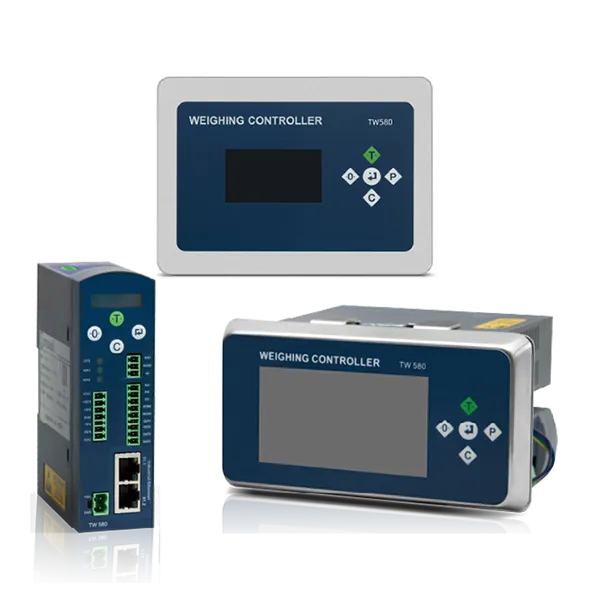
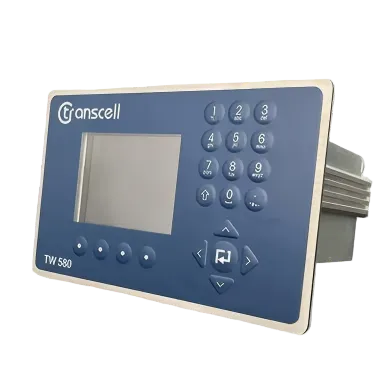
Transcell's TW580 specification is a useful example of how fast modern weighing electronics can operate. The current product specification lists a 960 Hz weight update rate, 960 Hz weight comparison rate, and 960 Hz PLC update rate. It also supports up to eight 350-ohm load cells and a maximum verification scale division of 10,000e. Those figures do not automatically guarantee process accuracy, but they show why controller performance has to be considered alongside the sensor and machine structure.
Which Components Belong in an Industrial Weighing System?
An industrial weighing system normally includes the load-bearing structure, load cells or weighing modules, a controller or instrument, power and signal wiring, process I/O, communications, and application-specific equipment such as feeders, valves, or refill devices.
The structure determines how force reaches the sensor. A well-specified sensor cannot compensate for a frame that twists or a tank that binds against rigid piping. Mounting hardware determines whether the force path remains repeatable. Junction boxes may combine multiple load-cell signals. Cables carry small electrical signals that can be vulnerable to damage and interference. The controller converts those signals into useful weight data and applies application logic. Digital outputs may operate feeders and valves, while digital inputs confirm states such as gate position, material level, or interlock status.
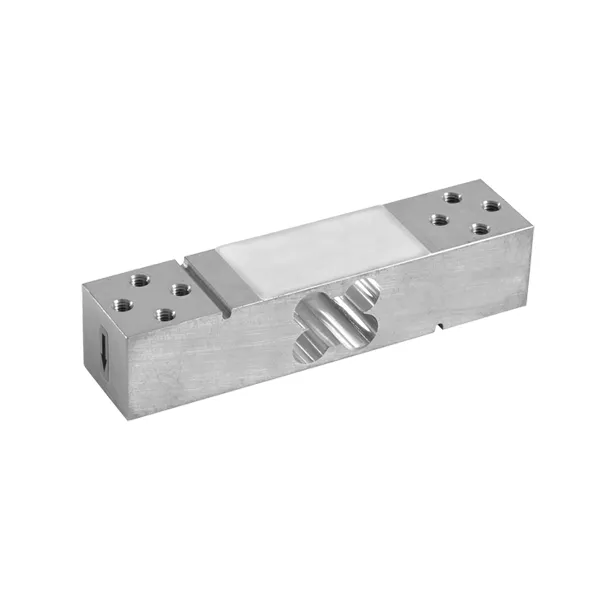
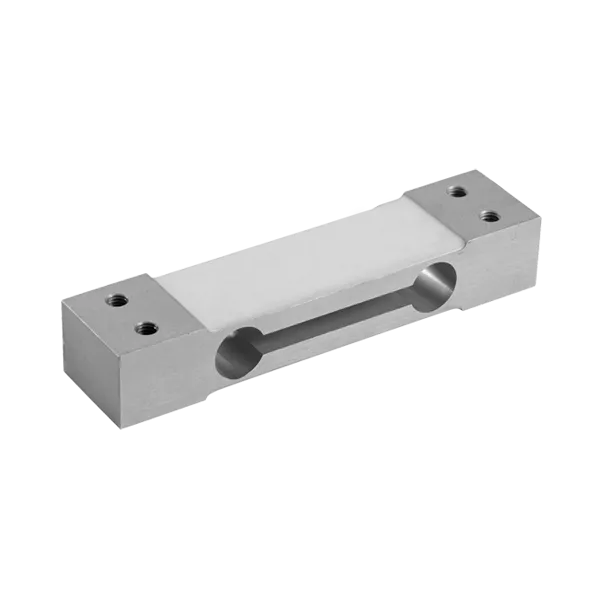
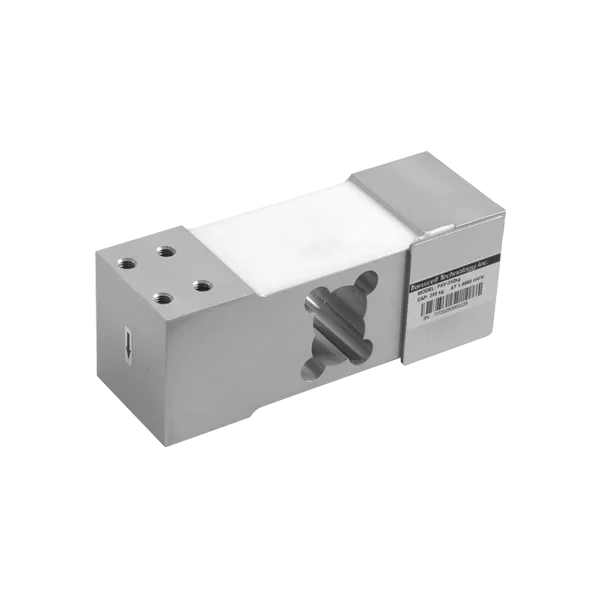
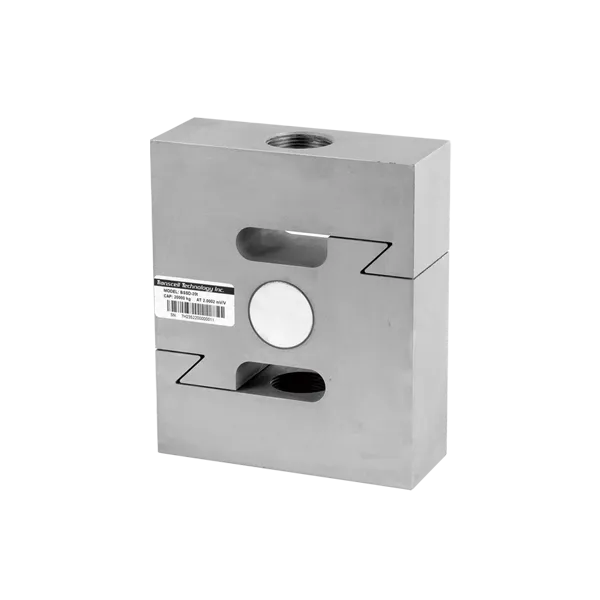
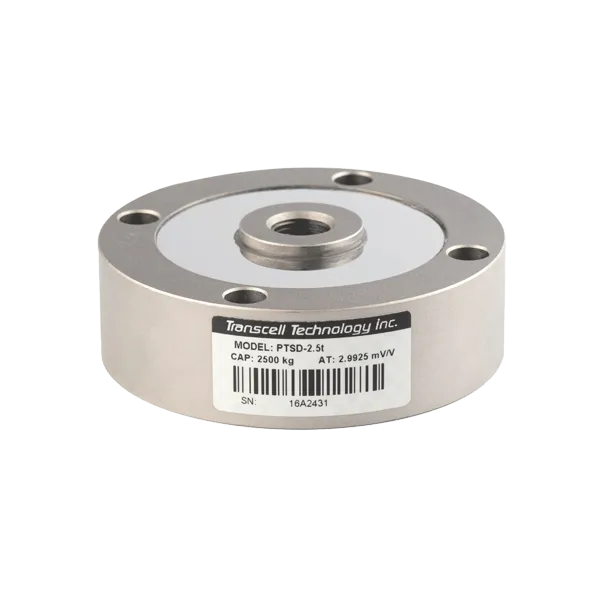
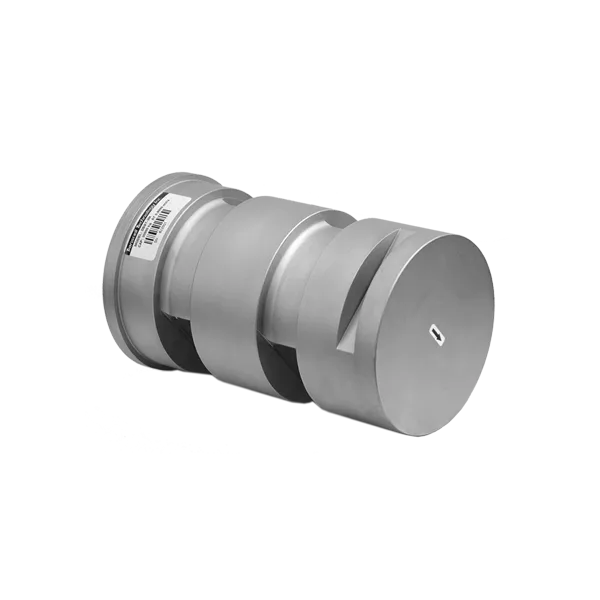
Sensor selection is especially important. A load cell for weighing machine must match capacity, direction of loading, mounting geometry, environment, and the usable measurement range. Transcell currently lists single-point, S-type, spoke-type, and dual-shear-beam load cells for applications that range from packaging and small hopper scales to testing machines and larger industrial weighing structures.
The controller then determines how the weight signal interacts with production. Transcell's TW580 supports applications including basic weighing, setpoint control, comparator functions, filling, packaging, checkweighing, and loss-in-weight control. The same specification lists Modbus TCP as standard connectivity, with optional industrial Ethernet protocols including PROFINET, EtherNet/IP, EtherCAT, Modbus TCP, and CC-Link IE Field Basic. For buyers, this is a reminder that the controller is not just a display; it is the bridge between the physical scale and the automation architecture.
How Should Industrial Weighing System Accuracy Be Defined?
Industrial weighing system accuracy should be defined by the process decision it supports, using repeatability, resolution, linearity, stability, sampling time, and dynamic response rather than a single headline percentage.
"We need 0.1% accuracy" is not yet a complete requirement. Is that 0.1% of full scale, of the actual load, of a batch target, or of a continuous flow setpoint? Is the requirement static or dynamic? Over what time interval? Under what vibration level? At what temperature? Does the process care more about absolute accuracy, short-term repeatability, or consistent cutoff behavior? The engineering answer changes depending on those details.
Suppose a 1,000 kg hopper batches 500 kg of material. If the production target allows a ±1 kg deviation, the system needs enough usable resolution and repeatability to support that tolerance after accounting for vibration, free-fall material, mechanical friction, and control delay. A controller that displays small increments may still fail the process if a rigid inlet duct applies several kilograms of parasitic force. Conversely, a system with moderate absolute calibration error may still deliver very repeatable batches if the control point is stable and the calibration procedure is disciplined.
Dynamic applications require a second question: how quickly must the weight signal become useful? Aggressive digital filtering can create a beautiful stable display while adding delay. Too little filtering can cause the controller to chase vibration. The correct balance depends on cycle speed, machine vibration, and the consequence of overshoot. That is why an industrial weighing system should be tested in the actual machine state, not only on a quiet commissioning day.
How Do You Size an Industrial Weighing System?
Sizing an industrial weighing system requires calculating dead load, maximum live load, number of support points, load distribution, shock and refill forces, overload margin, and the minimum weight change the process must reliably detect.
A common mistake is to size sensors only from product weight. Consider a stainless-steel hopper that weighs 600 kg empty and contains up to 1,400 kg of material. The gross supported load is 2,000 kg before accounting for piping reactions, refill impact, structural imbalance, or service loads. If four sensors are used and the load were perfectly even, the static share would be 500 kg per cell. Real systems are not perfectly even, so each sensor needs additional capacity. At the same time, specifying a sensor many times larger than necessary can reduce the proportion of full-scale signal used during normal operation.
The second sizing dimension is measurement range. Imagine that the 2,000 kg gross system must detect 0.5 kg changes reliably during a dosing step. That is a different challenge from a tank that only needs inventory indication within several kilograms. The cell capacity, controller resolution, structural stiffness, vibration environment, and filtering must be considered together.
Dynamic forces matter too. A refill valve may drop material from height. A mixer may transmit torque. A platform may experience forklift impact. A suspended vessel may shift laterally. These forces can create overload risk even if the static calculation appears comfortable. The correct safety factor is application-specific, which is why drawings, process descriptions, and operating scenarios should be part of the supplier discussion.
How Does an Industrial Weighing System Integrate with Feeding and Batching?
An industrial weighing system integrates with feeding and batching by using measured mass as the feedback signal for starting, slowing, stopping, or continuously adjusting material delivery.
Batching typically uses a target weight. A feeder or valve starts at a high rate, then transitions to a slower rate as the target approaches. The controller may stop the device before the displayed weight reaches the target because material is still falling. This is often called free-fall or in-flight compensation. A tolerance check then confirms whether the final batch is acceptable. The controller can record the result and continue to the next ingredient or process step.
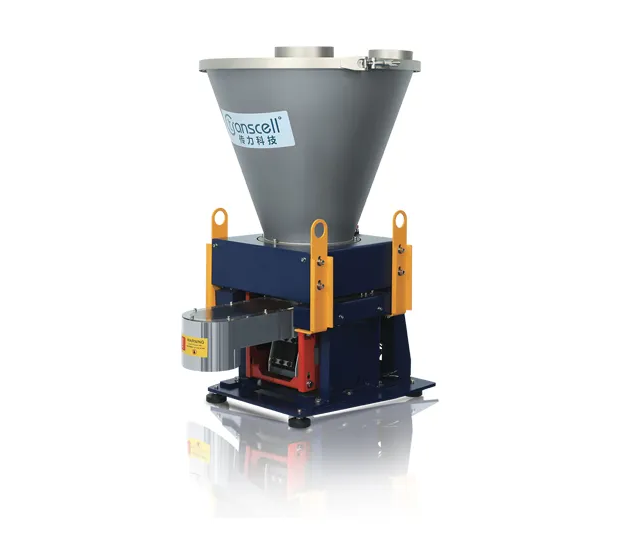
Continuous feeding uses a different logic. In a loss in weight feeder, the system measures the rate at which hopper weight decreases and compares that actual mass flow with a setpoint. The drive speed is corrected automatically. During refill, the control strategy has to account for the temporary increase in hopper weight before returning to normal gravimetric operation.
The integration boundary should be decided early. Does the local weighing controller own the sequence, while the PLC only sends recipes and start commands? Or does the PLC own all sequencing while the weighing controller provides fast weight values and local I/O? Either architecture can work. Problems arise when responsibility is unclear. A good functional design specification identifies who controls each valve, feeder, refill device, alarm, recipe, permissive, and fault response.
Which Industrial Weighing System Architecture Fits Your Application?
The best industrial weighing system architecture is the one that matches the required measurement speed, process risk, number of weighing points, automation level, maintenance capability, and future expansion plan.
| Architecture | Typical application | Control complexity | Main advantage | Main limitation |
|---|
| Local standalone weighing | Platform scales, manual ingredient verification, simple tanks | Low | Simple installation and troubleshooting | Limited automation and plant-wide data |
| Controller-based batching | Hoppers, filling, packaging, recipe dosing | Medium | Fast local weighing logic and deterministic I/O | Needs clear integration with PLC and recipe system |
| PLC-centered weighing | Multi-machine automated lines | Medium to high | Centralized sequence control and standardized programming | Performance depends on communications and PLC scan strategy |
| Distributed connected weighing | Multiple production cells, smart factories, data-driven operations | High | Scalable diagnostics, production data, and remote visibility | Requires stronger network, cybersecurity, and data governance |
| Continuous gravimetric control | Extrusion, compounding, chemical dosing, continuous manufacturing | High | Controls mass flow rather than only final batch weight | Mechanical isolation and refill behavior are critical |
The table is a practical framework, not a ranking. A simple local scale can produce excellent ROI if the decision is manual and the process is noncritical. A complex connected architecture adds value only when the plant can use the additional data, diagnostics, and automation. Procurement teams should therefore avoid specifying connectivity for its own sake. Every feature should support a production, maintenance, quality, or traceability requirement.
How Do Environment and Installation Affect Industrial Weighing System Reliability?
Industrial weighing system reliability depends heavily on installation because temperature, vibration, moisture, dust, washdown, piping forces, cable tension, and structural movement can all appear as weighing error or shorten component life.
Protection level is one practical consideration. Transcell's TW580 platform is available in several housing configurations. The current specification lists IP20 for the DIN-rail version, IP65 at the front panel for the panel-mount version, and IP66/IP69K for the dustproof version. The correct choice depends on where the electronics are mounted and what cleaning or environmental exposure they will face.
Mechanical installation is equally important. Rigid piping attached to a tank can bypass the sensors. A flexible connection that becomes taut can do the same. A cable tied tightly to a moving weigh frame can add an unpredictable force. Nearby motors, granulators, and mixers can introduce vibration. Sunlight or hot process equipment can create temperature gradients. A weighing system may therefore need flexible joints, proper support, vibration isolation, environmental protection, and deliberate cable routing.
Maintenance teams should also be able to inspect the force path. If access to the sensors is poor, small problems may remain hidden until calibration drift appears. A design that is slightly more expensive but easier to inspect, clean, and replace can have a lower lifecycle cost than a compact arrangement that turns every service job into a shutdown project.
What Data and Communications Should an Industrial Weighing System Provide?
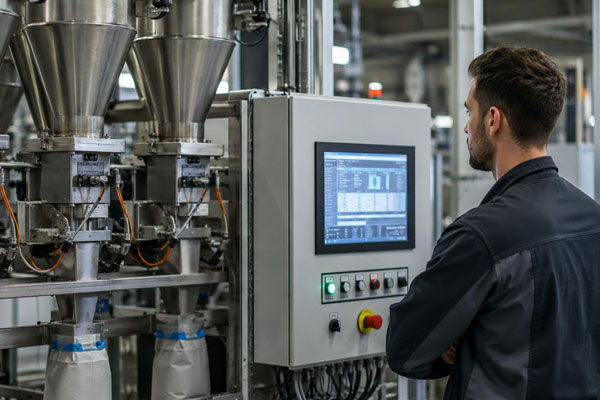
An industrial weighing system should provide the minimum data needed to operate, verify, diagnose, and improve the process, including live weight, status, alarms, setpoints, totals, calibration information, and relevant production records.
The required data depends on the use case. A tank inventory system may need gross weight, net weight, zero status, and high/low alarms. A filling system may need target, actual weight, fast/slow state, cutoff status, cycle result, and reject status. A continuous feeder may need setpoint, actual rate, screw speed, hopper weight, refill state, accumulated total, and deviation alarms. Logging every internal value is rarely useful. The goal is enough context to explain what happened.
Communication architecture should be selected before hardware is ordered. Transcell's weighing controller family supports several industrial communication options depending on model and configuration. The TW580 specification includes standard Modbus TCP and optional PROFINET, EtherNet/IP, EtherCAT, Modbus TCP, CC-Link IE Field Basic, analog output, Modbus RTU, RS232, and RS422/RS485 options. The TW580C specification likewise lists serial communications plus optional Ethernet and industrial Ethernet variants.
For the project team, the protocol name is only the beginning. The integration document should define data types, scaling, byte order where relevant, update expectations, heartbeat behavior, error codes, timeout response, and control ownership. It should also define what happens if communications fail. A feeder should not continue indefinitely with stale setpoints simply because the network cable was disconnected.
How Do You Validate an Industrial Weighing System Before Production?
Industrial weighing system validation should confirm static calibration, repeatability, dynamic behavior, I/O, communications, alarms, interlocks, and real-process performance before the system is accepted for routine production.
A useful validation sequence starts with mechanical inspection. Confirm that the structure is free, flexible connections are not binding, cables are supported correctly, and sensors are mounted as intended. Then perform zero and span calibration using appropriate test weights or another documented reference method. Repeat the loading cycle to check repeatability. For multi-cell systems, corner or support-point checks can reveal uneven load distribution.
Next, test dynamic operation. If the system fills a container, run several cycles at production speed and compare actual collected weight. If the system batches material, test fast-to-slow transition, free-fall compensation, tolerance alarms, and abort behavior. If the system controls continuous mass flow, test minimum, normal, and maximum rates, including refill transitions and disturbances.
Communications should be tested under normal and failure conditions. Disconnect the network or simulate a bad value and confirm that the machine reaches a safe, predictable state. Verify timestamps, batch identifiers, and totals if those records are used for quality or reconciliation. Finally, document the baseline values that maintenance can use later: zero condition, typical signal stability, normal cycle time, normal speed range, and alarm thresholds.
Why Choose Transcell for an Industrial Weighing System Project?
Transcell supports industrial weighing system projects with a portfolio that spans sensing, weighing electronics, material feeding, and intelligent control, helping customers coordinate components that directly affect measurement and automation performance.
According to the company profile, Transcell was founded in Chicago in 1981, and the Changzhou operation was officially established in 2010. The current site describes a business model covering R&D, design, production, sales, and service, with operations or presence across several regions. The company also lists quality and environmental management certificates, CE certificates for solid and liquid loss-in-weight feeders, and invention patent certificates.
For an industrial weighing system buyer, the practical advantage is application breadth. A project may begin with load cells and later require a controller, a feeder, or higher-level automation. A supplier that understands those interfaces can reduce the risk of mismatched signal ranges, control responsibilities, mechanical layouts, and communication requirements.
The best project discussion should begin with process data rather than a part number. Share the maximum and minimum loads, desired repeatability, cycle time, material behavior, installation drawing, environmental conditions, PLC platform, required communication protocol, available power, cleaning method, and expected expansion. That information allows the system architecture to be built around the plant rather than forcing the plant around a catalog device.
Industrial Weighing System FAQs
These industrial weighing system FAQs address the most common specification, integration, calibration, and purchasing questions raised by production and engineering teams.
1. What is the difference between a weighing scale and an industrial weighing system?
A scale can simply measure and display weight. An industrial weighing system usually includes the surrounding mechanical structure, sensors, controller, I/O, automation logic, communications, and process equipment required to use weight as part of production.
2. How many load cells should an industrial weighing system use?
The number depends on the machine structure and load path. Small platforms may use one single-point cell, while hoppers and tanks often use three or four support points. The correct layout should minimize uneven loading and make the structure stable and serviceable.
3. Can an industrial weighing system connect directly to a PLC?
Yes, provided the chosen controller or transmitter supports the required protocol or signal. Common options include industrial Ethernet, Modbus, analog outputs, and serial communications. The project should define data mapping and failure behavior before commissioning.
4. How often should an industrial weighing system be calibrated?
There is no universal interval. The schedule should reflect process criticality, environmental exposure, loading frequency, maintenance activity, and the quality system. Calibration should also be checked after sensor replacement, structural work, or other changes that can affect the force path.
5. What causes an industrial weighing system to drift even when the sensor is not damaged?
Common causes include material buildup, rigid piping, cable tension, temperature change, mounting movement, loose hardware, moisture, electrical noise, and process vibration. System-level troubleshooting should be performed before replacing a load cell.
6. What information should be provided when requesting an industrial weighing system quotation?
Provide the application, dead load, maximum live load, required accuracy or repeatability, cycle time, environment, number of weighing points, machine drawing, PLC or control platform, communications, power supply, material characteristics, and any hygiene or hazardous-area requirements.
Conclusion: Building an Industrial Weighing System Around the Process
A successful industrial weighing system is not defined by the most expensive sensor or the fastest controller; it is defined by how consistently the complete measurement-and-control chain supports the production decision.
Start with the process requirement. Define what must be measured, how quickly, and what happens when the value is reached. Size the sensors from gross mechanical load and usable measurement range. Protect the force path from unwanted loads. Select electronics with enough update speed, I/O, and communications for the application. Decide clearly whether local controllers or the PLC own the sequence. Validate both static and dynamic performance before production.
When those steps are followed, weighing becomes more than a display. It becomes a reliable control variable that can reduce material giveaway, improve batch consistency, support traceability, and make plant problems easier to diagnose. Transcell's combination of load cells, weighing controllers, loss-in-weight feeders, and intelligent control products provides a practical foundation for building that kind of connected industrial weighing architecture.
External References
The following independent resources provide additional background on industrial weighing requirements, measurement practice, and legal-for-trade weighing concepts.
 CN
CN